Things you may not have known
Discoveries
A nine-day queen, a canvas palace, and a king on the ramparts of Southsea Castle.
A reign of nine days
A mortally ill Edward VI bequeathed the Crown to Lady Jane Grey, a great-granddaughter of Henry VII. English Heritage says she reigned for only nine days before Mary I took the throne.
Sixteen hundred meals a day
Historic Royal Palaces says the kitchens at Hampton Court became an efficient food factory serving 1,600 meals a day, with up to 800 courtiers able to accompany the king.
H and A, still in the roof
In 1533 carpenters added Anne Boleyn’s coat-of-arms and carved the entwined letters H and A in the Great Hall. Historic Royal Palaces says those reminders can still be seen today.
Arrested at a game of tennis
Anne Boleyn was gambling on a game of tennis when she was arrested to be taken to the Tower, and complained that she could not collect her winnings.
Henry watched the Mary Rose go down
On 19 July 1545 the Mary Rose sank in the Solent. The Mary Rose Trust says Henry watched from Southsea Castle. She was 34 years old.
Not his sister’s name, on the official evidence
It is often claimed that the Mary Rose was named after Henry’s sister, Mary Tudor. The Mary Rose Trust says no evidence supports this.
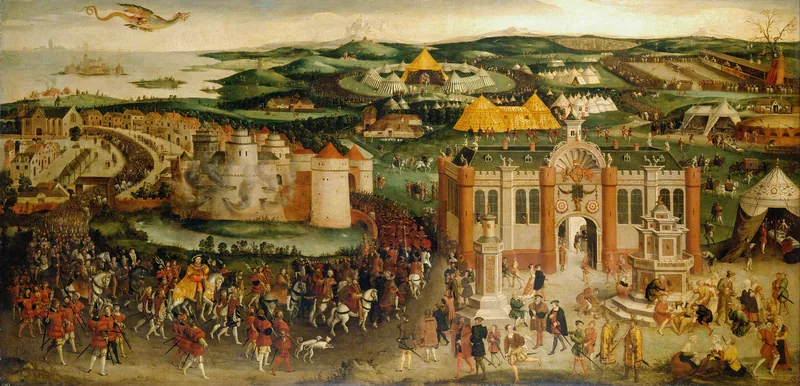
A palace of canvas, and a firework dragon
At the Field of the Cloth of Gold in June 1520, six thousand men built a temporary palace of canvas painted to look solid. A dragon or salamander firework was released on 23 June.
Fountains of wine, and a brawl in the picture
Two fountains in front of that temporary palace provided wine and beer. The official description of the painting notes figures being sick or brawling.
Eight fireships, and not one ship on fire
On the night of 28 July 1588 the English sent eight fireships among the Armada off Calais. No Spanish ship caught fire, but the fleet cut its cables and scattered.
A French fleet larger than the Armada
The Mary Rose Trust says the French fleet gathered in 1545 numbered over 200 ships, significantly larger than the Spanish Armada’s 130.
Victoria threw the gates open
In 1838 Queen Victoria ordered the gates of Hampton Court be thrown open to all her subjects. By 1881, over ten million visitors had been recorded.
Tapestries worth more than the rest
The Abraham tapestries were first hung in the Great Hall in 1546. After Charles I’s execution in 1649 they were valued at £8,260, the most valuable items in the Royal Collection.
The roll still listed a sunken ship
The Anthony Roll, presented to Henry VIII in 1546, is an inventory of the English navy. It includes the Mary Rose, which had sunk the previous year.
Eavesdroppers in the roof
Carved and painted heads, called Eavesdroppers, decorate the Great Hall roof. Historic Royal Palaces is not sure why they are there; perhaps as a warning to gossiping courtiers.
A favourite among more than 60 homes
Historic Royal Palaces says Henry VIII had over 60 homes, but Hampton Court Palace was his favourite.
Salvage was expected within weeks
The official Mary Rose timeline says salvage efforts began in August 1545, with an expected recovery date of 3 August 1545. The ship was raised on 11 October 1982.
Keep exploring
- Hampton Court — the hall, the kitchens, and the tennis court.
- The Mary Rose — the official career behind several of these stories.
- The fact file — official sentences, kept close to their sources.
Enjoyed this Tudor desk?
No pop-ups. No intrusive advertising. Just interesting stuff. A little support helps the next ages.im site get built.