Summer 1588
The Spanish Armada, and eight fireships that set no ship on fire
Beacons along the coast, a scatter off Calais, and a portrait that still holds a globe.
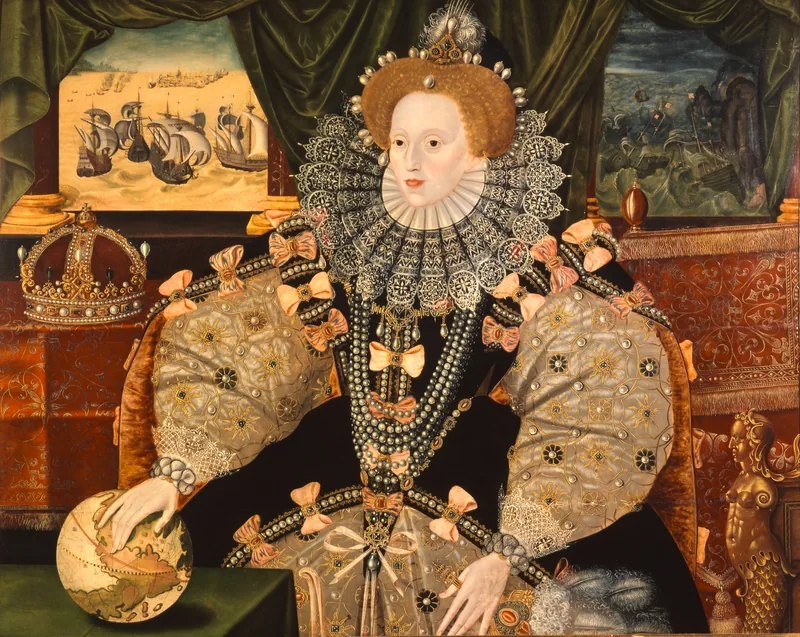
In December 1587, Royal Museums Greenwich says, Elizabeth I put Lord Howard of Effingham in charge of England’s defence. Drake was appointed his Vice-Admiral. On 19 July 1588 the Armada was sighted off the Lizard in Cornwall. “A fast English ship conveyed the news and a series of beacons were lit along the coast to spread the warning.” [source]
The English fleet at Plymouth inflicted some damage but could not stop the passage. The Armada anchored off Calais on 27 July. The Duke of Parma and his army had not yet arrived. On the night of 28 July the English sent in eight fireships. “Although no Spanish ships caught fire, the attack made the Spaniards panic, cut their anchor cables and scatter out to sea to avoid them.” [source]
A day of fierce fighting followed, later called the Battle of Gravelines. On 31 July the Spanish tried to turn back to join Parma, but the prevailing south-west winds prevented them. They gave up and sailed north around Scotland. Howard pursued them into the North Sea for three days. “Bad storms completed the Spanish defeat: many of their fleeing Spanish ships were wrecked off the coasts of Scotland and Ireland. Less than half the fleet made it back to Spain.” [source]
The Armada Portrait, the same museum says, “commemorates the most famous conflict of Elizabeth I’s reign — the failed invasion of England by the Spanish Armada in summer 1588.” [source]
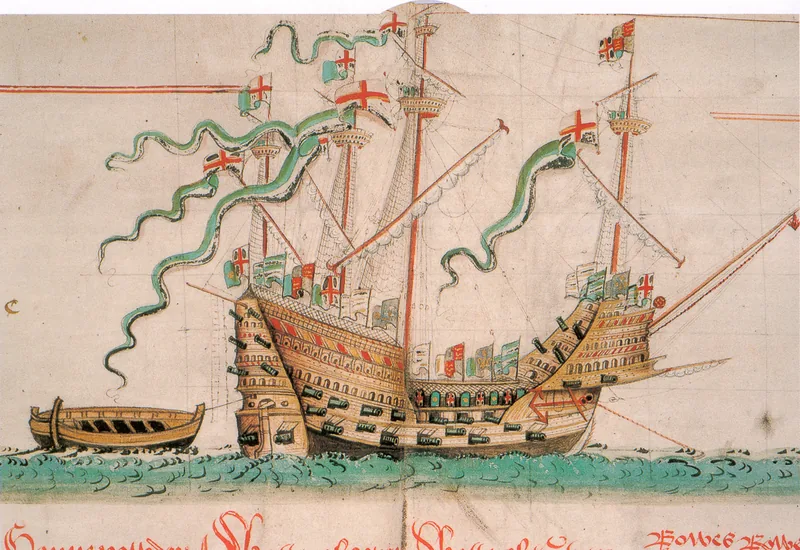
A generation earlier, the Mary Rose Trust notes that the French fleet gathered in 1545 — “over 200 ships” — was “significantly larger than the Spanish Armada… which totalled 130 ships.” Those figures belong to that official comparison, on that page. [source]
Keep exploring
- The Tudor monarchs — Elizabeth’s reign, and Mary, Queen of Scots in 1587.
- The Mary Rose — another official naval story, 43 years earlier.
- Discoveries — fireships, nine days, and a firework dragon.
Enjoyed this Tudor desk?
No pop-ups. No intrusive advertising. Just interesting stuff. A little support helps the next ages.im site get built.