A fact file
Official sentences, kept close to their sources
Every fact on this page is taken from an official English Heritage, Historic Royal Palaces, Mary Rose Trust, Royal Museums Greenwich, Royal Collection or National Archives page, checked on 17 November 2026.
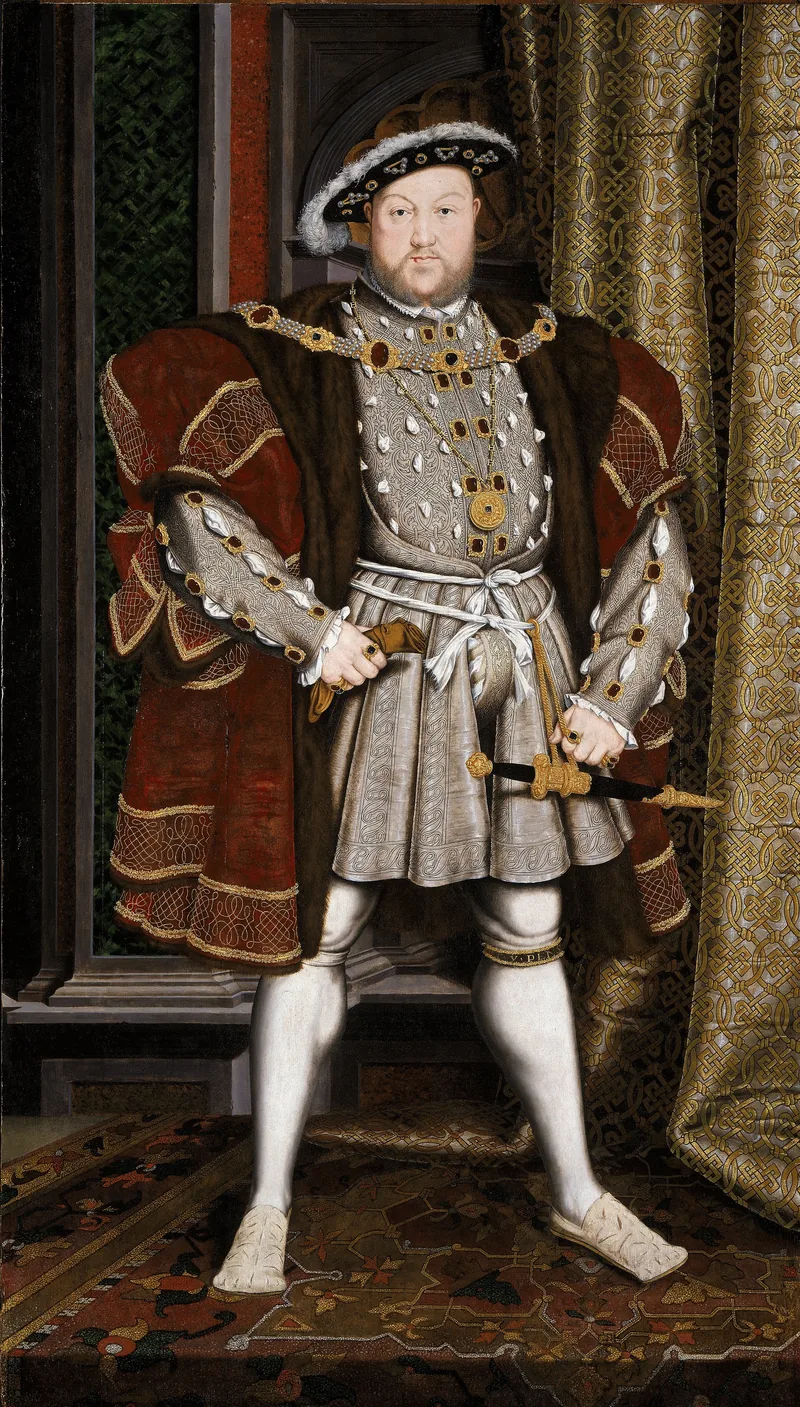
English Heritage titles its introduction “An Introduction to Tudor England (1485–1603).” ([source])
“England underwent huge changes during the reigns of three generations of Tudor monarchs.” ([source])
Henry VII’s (r.1485–1509) victory against Richard III at the Battle of Bosworth ended the Wars of the Roses. ([source])
The Tudor era began with that victory in 1485, ending the Wars of the Roses. ([source])
Henry VIII reigned 1509–47. ([source])
In 1533 Henry declared that he, not the Pope, was the head of the Church in England. ([source])
That decision initiated the Reformation of English religion, “the most crucial event of the Tudor period.” ([source])
Along with Thomas Cromwell, Henry launched the Suppression, also known as Dissolution, of the Monasteries (1536–40). ([source])
The Pilgrimage of Grace took place in 1536–7. ([source])
Castle Acre Priory was dissolved in 1537. ([source])
Edward VI reigned 1547–53, and is called “the bookish boy-king” on the official page. ([source])
There was a West Country rising against the new Protestant Book of Common Prayer in 1549. ([source])
A mortally ill Edward bequeathed the Crown to Lady Jane Grey, a great-granddaughter of Henry VII. ([source])
Lady Jane Grey reigned for only nine days before being ousted by a tide of enthusiasm for Mary I. ([source])
Mary I reigned 1553–8. ([source])
Mary I, “a convinced Catholic,” immediately set about reversing the Reformation. ([source])
Elizabeth I reigned 1558–1603. ([source])
Mary, Queen of Scots was executed in 1587 by order of Elizabeth I. ([source])
The National Archives uses the heading “Early modern (1485–1714)” for a span covering the Tudor, Stuart and English Civil War eras. ([source])
On that National Archives page, “Elizabeth I (1533–1603)” is a birth-to-death span. ([source])
The original Tudor Hampton Court Palace was begun by Cardinal Thomas Wolsey in the early 16th century. ([source])
Henry VIII brought all his six wives to Hampton Court. ([source])
Wolsey was so successful that Henry eventually took Hampton Court for himself. The story page does not give a year for that takeover. ([source])
By the 1530s, Henry VIII’s Hampton Court was a palace, a hotel, a theatre and a vast leisure complex. ([source])
Around Base Court there were 30 suites of lodgings used for the grandest visitors. ([source])
Up to 800 courtiers could accompany Henry VIII; all needed to be fed. ([source])
The kitchens became an efficient food factory serving 1,600 meals a day. ([source])
The King enlarged the existing Great Kitchen, built in the late 1400s by a former resident, Lord Daubeney. ([source])
Jane Seymour died giving the King a longed-for son, Edward, later Edward VI. ([source])
Catherine Howard was arrested at Hampton Court and later executed at the Tower of London for adultery and treason. ([source])
In 1838 Queen Victoria ordered the gates of Hampton Court Palace be thrown open to all her subjects. ([source])
By 1881, over ten million visitors had been recorded. ([source])
Henry VIII had over 60 homes, but Hampton Court Palace was his favourite. ([source])
As many as a thousand courtiers and their servants would cram into Hampton Court, on the court page’s wording. ([source])
Masons and bricklayers began work on the present Great Hall in 1532. ([source])
They replaced a smaller hall built between 1495 and 1514, later remodelled by Wolsey. ([source])
Wolsey died in disgrace in 1530, having failed to secure the annulment of Henry’s marriage to Katherine of Aragon. ([source])
By that time, Henry had taken over Wolsey’s palace at Hampton Court. ([source])
Carpenters began working on the Great Hall’s timber roof in 1533. ([source])
They added Anne Boleyn’s coat-of-arms to the roof and carved the entwined letters H and A on the wooden screen. ([source])
The roof also features Anne’s falcon badge and the initials AR for Anna Regina. ([source])
Those reminders of Anne’s time as queen can still be seen today. ([source])
Carved and painted heads called Eavesdroppers decorate the roof; Historic Royal Palaces is not sure why they were placed there. ([source])
The Abraham tapestries were first hung in the Great Hall in 1546. ([source])
They were woven in Brussels from wool, silk, and gold and silver thread. ([source])
After the execution of Charles I in 1649, the Abraham tapestries were valued at £8,260, the most valuable items in the Royal Collection. ([source])
On a day-to-day basis the Great Hall acted as a large refectory for lower-ranking members of the royal household and servants. ([source])
Dinner sittings started at 10 o’clock in the morning and supper at 4 o’clock in the afternoon. ([source])
James I’s court spent Christmas and New Year 1603–4 at Hampton Court to escape plague in London, and Shakespeare’s company performed A Midsummer Night’s Dream in the Great Hall. ([source])
The stained-glass windows of the Great Hall were added during Edward Jesse’s restoration in the 1840s. ([source])
Historic Royal Palaces calls tennis the favourite game of Henry VIII. ([source])
In 1519 the Venetian Ambassador wrote that it was the prettiest thing in the world to see Henry play, his fair skin glowing through a shirt of the finest texture. ([source])
Anne Boleyn was gambling on a game of tennis when she was arrested to be taken to the Tower, and complained that she could not collect her winnings. ([source])
The first tennis court at Hampton Court was built for Cardinal Wolsey between 1526 and 1529. ([source])
The current tennis court was built for Charles I in 1625; one external wall is one of Wolsey’s originals. ([source])
The Mary Rose was built in 1510–11 and was one of Henry’s favourite ships for 34 years, until she sank in 1545. ([source])
Henry’s fleet grew from five ships at the start of his reign to 53 by his death in 1547. ([source])
The earliest reference to the Mary Rose is 29 January 1510, in a letter ordering the construction of two new ships. ([source])
Those ships were the Mary Rose and the Peter Pomegranate, built at Portsmouth. ([source])
The Trust says no evidence supports the claim that the ship was named after Henry’s sister, Mary Tudor. ([source])
The Mary Rose was 600 tons, the Peter Pomegranate 450. ([source])
Her maiden voyage as a warship was 17 April 1512. ([source])
In 1520 the Mary Rose escorted Henry VIII to the Field of the Cloth of Gold. ([source])
On 30 May 1522, at 2pm, Henry and Charles V boarded and inspected the Henry Grace à Dieu and the Mary Rose. ([source])
On 19 July 1545 the Mary Rose sank during the Battle of the Solent. ([source])
Henry watched from Southsea Castle as the battle progressed. ([source])
The only confirmed eyewitness was a Flemish sailor who escaped from the sinking vessel. ([source])
Francois van der Delft, writing on 24 July 1545, said about 500 men were drowned save about 25 or 30. ([source])
The Mary Rose was 34 years old when she sank, and had travelled from Scotland to the Atlantic coast of France. ([source])
The French fleet gathered in 1545 numbered over 200 ships, significantly larger, the Trust says, than the Spanish Armada’s 130. ([source])
The English amassed around 80 ships in 1545. ([source])
Salvage efforts began in August 1545, with an expected recovery date of 3 August 1545. ([source])
The Anthony Roll, an inventory of the English navy presented to Henry in 1546, includes the Mary Rose, which had sunk the previous year. ([source])
The Mary Rose was raised on 11 October 1982. ([source])
The meeting known as the Field of the Cloth of Gold took place between 7 and 24 June 1520 near Guînes, south of Calais. ([source])
A temporary palace was erected by six thousand men from England and Flanders. ([source])
The palace stood on brick foundations, but the walls and roof were canvas painted to look solid, with windows of real glass. ([source])
Two fountains in front provided wine and beer; some figures in the painting are sick or brawling. ([source])
A dragon or salamander firework was released on 23 June 1520. ([source])
Henry entered Guînes on 5 June 1520, accompanied by Catherine of Aragon. ([source])
The painting is British School, circa 1545, previously attributed to Holbein, inventory number RCIN 405794. ([source])
In December 1587 Elizabeth I put Lord Howard of Effingham in charge of England’s defence against the Spanish Armada. ([source])
On 19 July 1588 the Armada was sighted off the Lizard in Cornwall, and beacons were lit along the coast. ([source])
The Armada anchored off Calais on 27 July 1588. ([source])
On the night of 28 July the English sent in eight fireships. ([source])
No Spanish ships caught fire, but the Spaniards cut their anchor cables and scattered. ([source])
A day of fighting followed, later called the Battle of Gravelines. ([source])
On 31 July 1588 prevailing south-west winds prevented the Spanish from turning back to join Parma. ([source])
They returned to Spain by sailing north around Scotland; Howard pursued them into the North Sea for three days. ([source])
Many fleeing ships were wrecked off Scotland and Ireland, and less than half the fleet made it back to Spain, in Royal Museums Greenwich’s wording. ([source])
The Armada Portrait commemorates the failed invasion of England by the Spanish Armada in summer 1588. ([source])
Religious conflict followed the Reformation, which began in 1533, but art and commerce flourished, on the English Heritage hub’s wording. ([source])
Keep exploring
- Sources — the official pages themselves.
- Field notes — the official nuances, gathered in one place.
- Discoveries — the same record, told as stories.
Enjoyed this Tudor desk?
No pop-ups. No intrusive advertising. Just interesting stuff. A little support helps the next ages.im site get built.